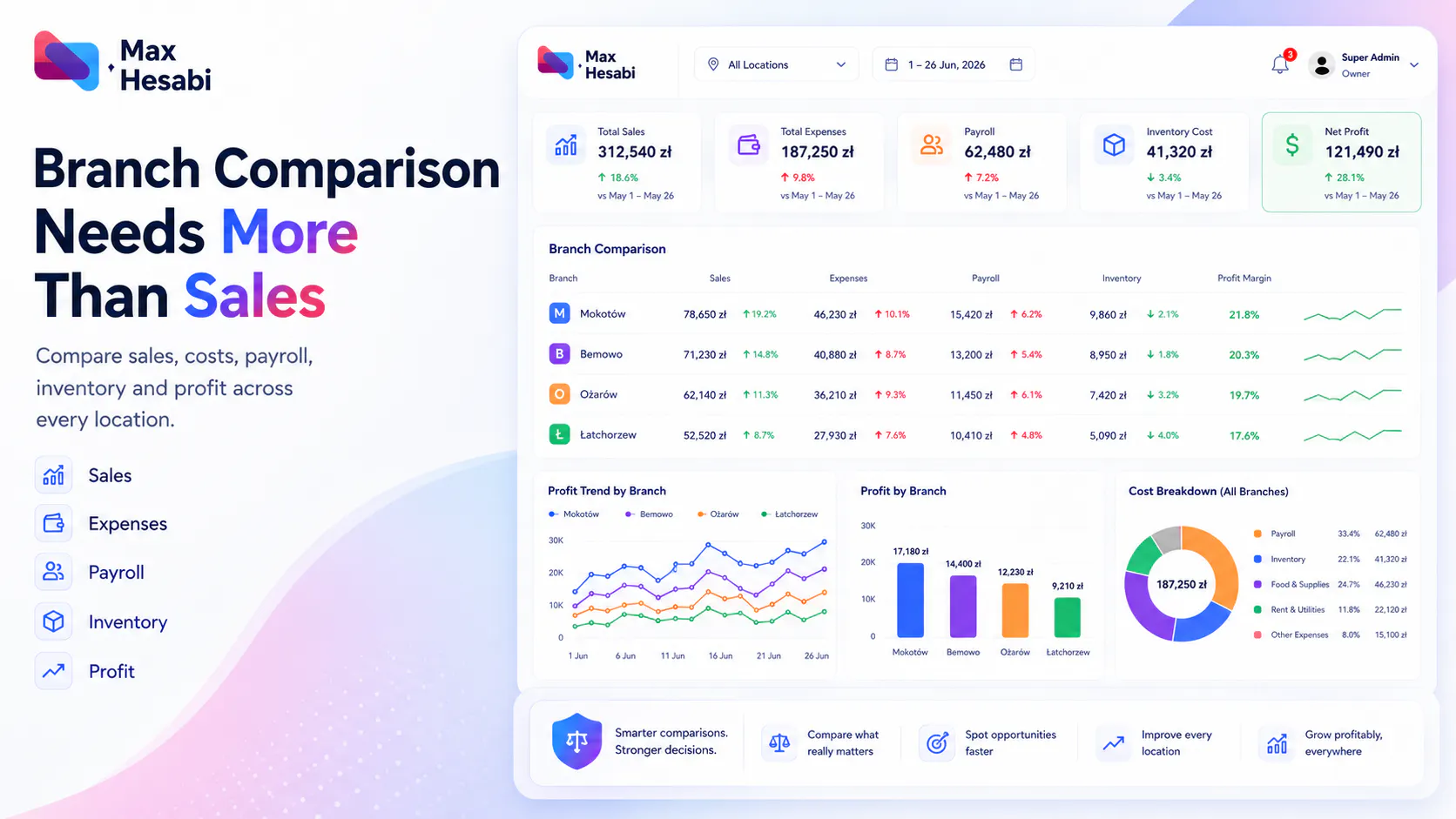
How Multi-Location Restaurants Can Compare Branch Performance
Learn how multi-location restaurant operators can compare sales, expenses, payroll, inventory, suppliers, and profit across every branch.
Branch Comparison Needs More Than Sales Numbers
When a restaurant business grows beyond one location, performance becomes harder to understand from total company numbers alone. One branch may be growing, another may be losing margin, and another may look busy while costs are too high.
Multi-location restaurant operators need a clear way to compare sales, expenses, payroll, inventory, suppliers, and profit by branch. Without that view, weak locations can hide inside strong overall revenue.
Why Total Sales Can Be Misleading
Sales are important, but they do not tell the full story. A branch with high sales may still produce lower profit if expenses, payroll, supplier purchases, or stock usage are too high.
When comparing branches, owners should look at:
- Daily and monthly sales
- Expense categories
- Staff and payroll costs
- Inventory usage and waste
- Supplier purchases and balances
- Refunds, discounts, and adjustments
- Final profit by location
This gives owners a fairer picture of which branches are truly performing well.
Compare Sales by Location and Period
Start by reviewing sales for each location across the same time period. Compare daily, weekly, and monthly results so you can see patterns instead of reacting to one unusual day.
Useful sales comparison questions include:
- Which branch has the strongest daily sales?
- Which location is growing fastest?
- Are weekends performing differently by branch?
- Are delivery platform sales stronger in one location?
- Are refunds or discounts increasing anywhere?
Sales comparison works best when every branch records revenue consistently and under the correct location.
Review Expenses by Branch
Expenses can explain why two branches with similar sales produce different profit. Rent, repairs, utilities, packaging, delivery fees, cleaning supplies, and daily operating costs may vary widely by location.
Owners should compare expense categories across branches to spot unusual increases. If one location spends more on repairs or packaging than others, it may need attention before the issue becomes normal.
Watch Payroll Against Branch Revenue
Payroll is often one of the largest costs in restaurant operations. A location may have strong sales but weak profit if staff costs are too high for the level of demand.
When comparing payroll, review:
- Staff costs by location
- Payroll compared with sales
- Payroll compared with profit
- Manager notes for unusually busy or slow days
- Locations where labor costs are rising faster than revenue
This helps owners understand whether staffing levels match real business activity.
Compare Inventory Usage and Waste
Inventory differences can reveal hidden problems. One branch may use more meat, ingredients, drinks, or packaging than expected, while another may have better stock discipline.
Location-level inventory comparison helps owners identify:
- Branches using more stock than sales justify
- Locations with more damaged or wasted items
- Branches that run low too often
- Inventory transfers between locations
- Stock items that need better rules or training
Inventory should be reviewed with sales and supplier purchases, not separately.
Review Supplier Purchases by Location
Supplier purchases help explain both cost and stock movement. If one branch buys more than expected, owners need to know whether the purchases match sales, stock usage, waste, and manager reports.
Compare supplier activity to understand:
- Which suppliers are used most often by each branch
- Whether purchase costs are increasing
- Which location is ordering more than expected
- Whether supplier balances are clear
- Whether purchases match inventory usage
This makes supplier spending part of the branch performance picture.
Use Manager Notes to Explain the Numbers
Numbers are stronger when managers add context. A branch may have lower sales because of bad weather, road works, a staffing issue, a local event, a delivery platform problem, or a temporary closure.
Manager notes help owners understand why a branch performed differently instead of guessing from the report alone.
Measure Real Profit by Branch
The most useful comparison is not only which branch sold the most. It is which branch produced the healthiest profit after expenses, payroll, supplier costs, inventory usage, refunds, and adjustments.
A smaller branch can sometimes be more profitable than a larger branch if costs are controlled better. Profit reporting helps owners see that difference clearly.
How Max Hesabi Helps Multi-Location Operators
Max Hesabi helps restaurant owners bring branch activity into one connected system. Instead of reviewing sales, expenses, staff costs, inventory, and suppliers separately, owners can compare how each area affects location performance.
Multi-location operators can use Max Hesabi to:
- Track daily sales by branch
- Record expenses by category and location
- Review payroll and staff costs by branch
- Monitor inventory usage, waste, and low-stock activity
- Connect supplier purchases with locations
- Compare location profit more clearly
- Spot operational issues before month-end
A Simple Branch Performance Checklist
Sales are recorded by location
Each branch has clean daily sales records for accurate comparison.
Expenses are categorized consistently
Costs can be compared across locations without confusion.
Payroll is reviewed with revenue
Staff costs are checked beside sales and profit, not in isolation.
Inventory is compared by branch
Stock usage, waste, transfers, and low-stock issues are reviewed location by location.
Supplier purchases are connected
Purchases are assigned to the correct branch and reviewed with inventory activity.
Profit is the final measure
Owners compare real location profit, not only revenue.
Final Thought
Multi-location restaurant growth creates opportunity, but it also creates blind spots. Owners need more than total sales to understand what is really happening across the business.
When every branch is compared with the same structure, owners can see which locations are growing well, which ones need attention, and where profit can be protected.