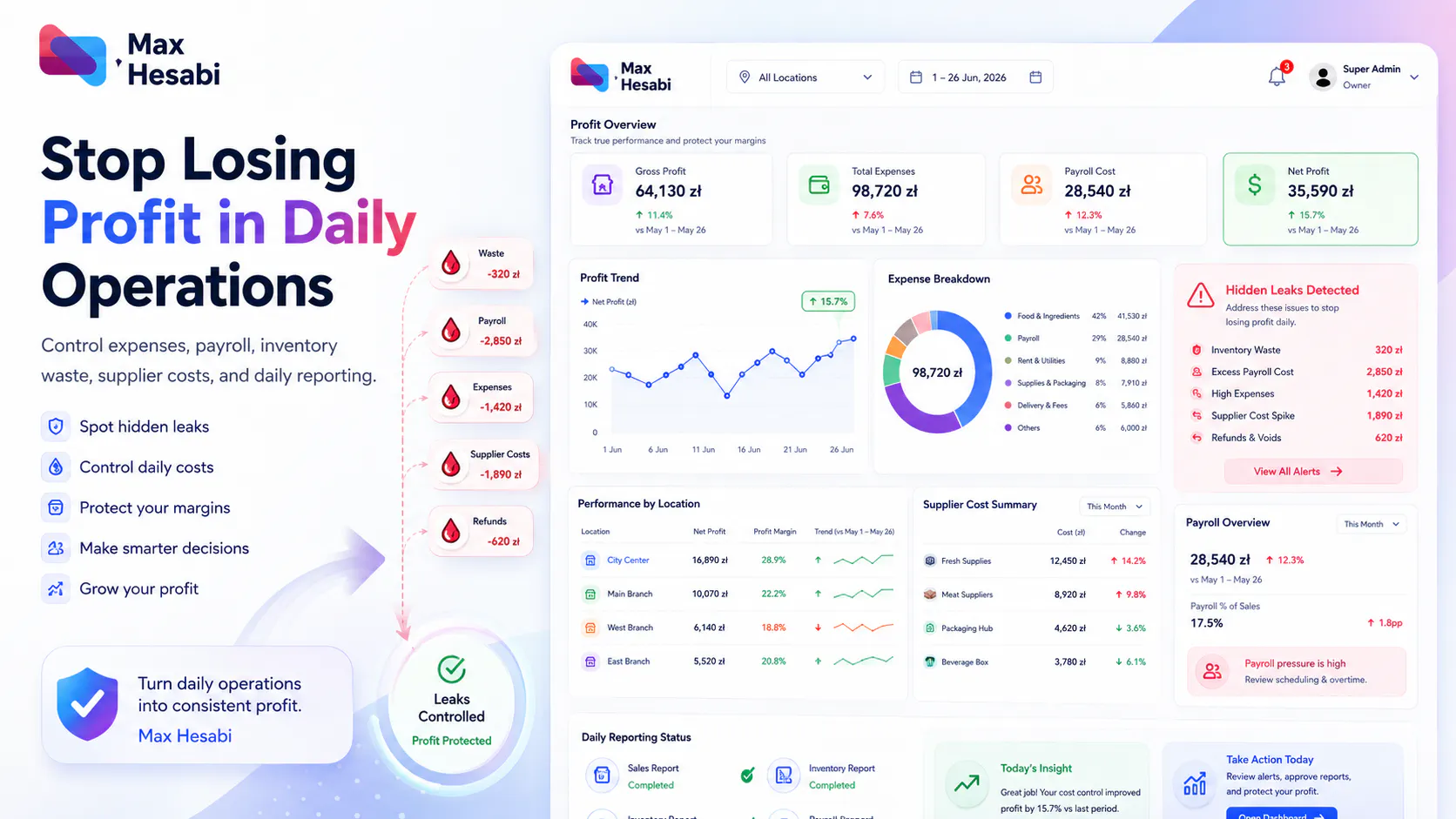
How Restaurant Owners Can Stop Losing Profit in Daily Operations
Hidden losses often come from daily details: unclear expenses, weak inventory control, payroll pressure, supplier costs, waste, refunds, and late reporting. Here is how restaurant owners can spot and reduce them with better operational tracking.
Profit Is Often Lost in the Small Daily Details
Many restaurant owners know their sales numbers, but still struggle to understand why profit is lower than expected. The issue is usually not one big mistake. It is often a collection of small daily leaks across expenses, stock usage, payroll, supplier purchases, refunds, and reporting delays.
A busy restaurant, kebab shop, cafe, or food business can look healthy on the surface while profit quietly disappears behind the scenes. To fix that, owners need clearer daily operations, not just month-end accounting.
Where Restaurant Profit Commonly Disappears
Profit loss usually starts when key information is scattered across different tools, messages, invoices, and spreadsheets. When owners cannot see the full picture, it becomes harder to act early.
Common areas where restaurants lose profit include:
- Expenses recorded late or without clear categories
- Meat, ingredients, packaging, or drinks used faster than expected
- Supplier purchases not connected with inventory or location reports
- Payroll costs rising faster than sales
- Refunds, discounts, or adjustments not reviewed regularly
- Branch managers reporting activity inconsistently
- Owners waiting until month-end to discover problems
1. Track Expenses Before They Become Unclear
Small expenses add up quickly in food service. Repairs, packaging, delivery platform fees, cleaning supplies, utilities, and emergency purchases can quietly reduce profit if they are not recorded clearly.
Restaurant owners should organize expenses into categories that match how the business actually runs. This makes it easier to see which costs are growing and which locations need attention.
Instead of asking “Why is profit lower this month?”, owners can ask better questions such as “Did packaging costs rise?”, “Did repairs affect one branch?”, or “Are delivery fees increasing faster than sales?”
2. Connect Inventory with Real Usage
Inventory is one of the biggest sources of hidden loss. If stock is only counted occasionally, owners may miss waste, damage, overuse, theft, or purchasing mistakes.
Restaurants and kebab shops should pay close attention to high-impact items such as meat, core ingredients, drinks, packaging, and daily supplies. These items affect profit directly and often move quickly.
Good inventory tracking should show what was purchased, what was used, what was damaged, what was transferred, and what is running low.
3. Review Supplier Purchases with Location Performance
Supplier purchases are not just invoices. They are part of the profit story. If one location buys more stock than expected, owners need to know whether that matches sales, inventory usage, and manager activity.
Supplier records should help owners understand:
- Which suppliers are used most often
- Which locations are buying more than expected
- Whether purchase costs are increasing
- Whether supplier balances are clear
- Whether purchases match stock usage
When supplier costs are connected with inventory and sales, owners can catch problems earlier.
4. Watch Payroll Against Sales
Payroll is one of the largest recurring costs in a restaurant. A strong sales day can still produce weak profit if too many staff hours were used or employee payments were not planned well.
Owners should review staff costs beside sales and branch performance. This helps answer practical questions:
- Did labor costs rise faster than sales?
- Is one location spending more on staff than others?
- Were staffing levels unusually high for a slow day?
- Do manager notes explain why payroll changed?
Payroll should never be reviewed separately from operational performance.
5. Compare Locations Fairly
For multi-location restaurants, profit loss can hide inside averages. One branch may be performing well while another branch is quietly losing margin. If the owner only sees total company sales, the weaker location may go unnoticed.
A fair location comparison should include sales, expenses, payroll, supplier purchases, inventory usage, refunds, and manager notes. A smaller branch can sometimes be more profitable than a larger branch if costs are controlled better.
6. Do Not Wait Until Month-End
Month-end reports are useful, but they are too late for many daily operational problems. If meat usage is too high, stock is damaged, payroll is rising, or expenses are being miscategorized, owners need to know while there is still time to act.
A better rhythm is to review key numbers weekly, and for busy businesses, daily. This does not mean spending hours on reports. It means making sure the right information is recorded in the right place as work happens.
How Max Hesabi Helps Reduce Profit Leaks
Max Hesabi is designed to bring restaurant accounting and operations into one connected system. Instead of separating sales, expenses, inventory, suppliers, staff costs, and reporting, it helps owners see how those areas affect each other.
Restaurant owners can use Max Hesabi to:
- Track daily sales and payment breakdowns
- Record expenses by category and location
- Monitor inventory, meat usage, damaged items, and low-stock warnings
- Organize suppliers, purchases, and balances
- Track staff costs and employee payments
- Compare performance across locations
- Review profit reports with more confidence
A Simple Profit Protection Checklist
Record expenses daily
Do not wait until the end of the month to understand where money went.
Track important inventory items
Focus first on meat, ingredients, packaging, drinks, and high-cost supplies.
Connect purchases to suppliers
Supplier costs should be easy to review by location and reporting period.
Review payroll with sales
Labor costs should be checked beside revenue and branch performance.
Compare locations regularly
Look for branches where sales, expenses, stock usage, or payroll look unusual.
Use reports to act early
Profit reporting is most useful when it helps owners fix issues before they grow.
Final Thought
Restaurant profit is protected through daily visibility. Owners do not need more scattered spreadsheets or late reports. They need a clear way to see sales, expenses, inventory, suppliers, staff costs, and profit together.
When daily operations are tracked properly, owners can stop guessing where profit went and start making better decisions with current numbers.